

SYMPHONY-PE Trial demonstrated strong safety results with no deaths and no device-related serious adverse events.October 23, 2025
By: Michael Barbella
Managing Editor
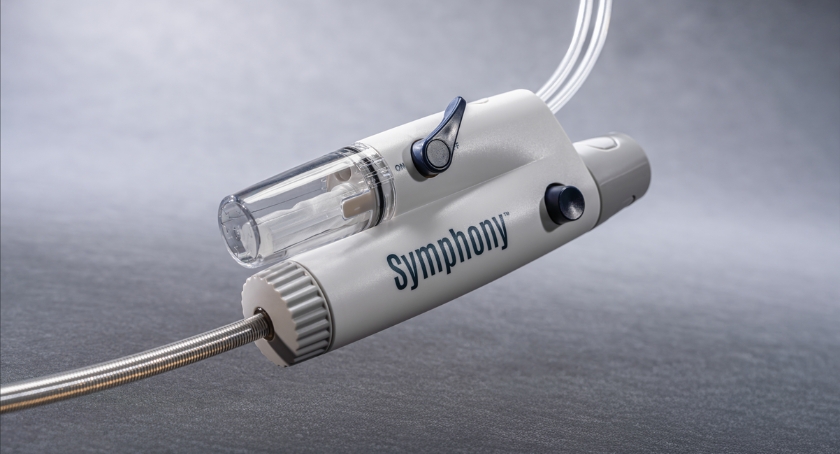
Imperative Care Inc. is sharing positive efficacy and safety results from the pivotal SYMPHONY-PE Trial, which evaluated the company’s Symphony Thrombectomy System for acute pulmonary embolism (PE) treatment.
The SYMPHONY-PE Trial results have been published in Circulation: Cardiovascular Interventions in a paper, “A Prospective Multicenter IDE Study of the Next-Generation Precision Aspiration Thrombectomy System for Intermediate-Risk Pulmonary Embolism: The SYMPHONY-PE Trial.” Symphony demonstrated a strong safety profile, high efficacy, and procedural efficiency, according to study results. Notably, there were no device-related serious adverse events (SAE), with marked clot-burden reduction, short device-use time, and minimal blood loss.
“The trial results demonstrated significant improvements in right ventricle–to–left ventricle (RV/LV) ratio, systolic and mean pulmonary artery pressures (PAP), and clot burden, with no device-related SAE and no mortality reported at 30 days,” said co-national principal investigator Vivian L. Bishay, M.D., associate professor in the Department of Diagnostic, Molecular, and Interventional Radiology at the Mount Sinai Health System. “These findings represent clinically meaningful progress in PE treatment, underscoring the device’s excellent safety profile. The ability to bring a large-bore catheter directly to the clot and safely deliver continuous aspiration marks an emerging paradigm shift in PE intervention. I look forward to the device’s continued impact in my practice.”
The prospective Investigational Device Exemption (IDE) trial evaluated 109 patients with acute intermediate-risk PE across 17 U.S. institutions. The trial was led by Dr. Bishay and national co-principal investigator Sripal Bangalore, M.D., professor in the Department of Medicine at NYU Grossman School of Medicine and lead author of the peer-reviewed paper.
“Rapid thrombus removal using large-bore mechanical thrombectomy has the potential to improve patient hemodynamics, relieve right-heart strain, and reduce short-term morbidity and mortality in PE,” Dr. Bangalore stated. “The excellent safety and efficacy demonstrated in this trial, together with short device-use times and minimal blood loss, underscore Symphony’s ability to address a critical unmet need by combining the advantages of large-bore continuous aspiration with the exceptional safety of real-time vacuum control.”
The trial met its pre-specified primary efficacy and safety endpoints, with results demonstrating:
- Efficacy: the core laboratory independently adjudicated a mean RV/LV reduction of 0.44 ± 0.42 from baseline to 48 hours. The lower bound of the 97.5 % confidence interval (0.36) exceeded the prespecified performance goal of > 0.20 (p < 0.001).
- Safety: the independent safety board adjudicated the major adverse event (MAE) rate, a composite of all-cause major bleeding, device-related deaths, and device-related SAE rate within 48 hours of the procedure, at 0.9 % (1/109). The 97.5% upper confidence interval bound (5.7 %) was significantly lower than the 15% performance goal (p < 0.001).
“Symphony demonstrated an exceptional ability to deliver immediate and sustained objective and subjective improvements, achieving a 12 mmHg reduction in systolic pulmonary artery pressure and a 7 mmHg reduction in mean pulmonary artery pressure after aspiration, along with a 38.4% decrease in clot burden at 48 hours—all with a notably short device-use time and no safety concerns,” said Dr. Dana Tomalty, M.D., peripheral and neuro interventional radiologist at Huntsville Hospital and the trial’s highest enroller. “These results appear to set a new benchmark for efficiency and safety in PE intervention. I am eager to bring this technology into routine clinical practice to improve outcomes for patients with acute PE.”
The Symphony Thrombectomy System is an aspiration catheter system engineered to deliver more efficient and effective clot removal in patients with venous thromboembolism (VTE). Symphony combines large-bore power with precise deep vacuum, giving physicians full control to remove more clot in less time. By delivering continuous deep vacuum closer to the clot, Symphony generates a Deep Pulse, a powerful aspiration pulse that provides greater clot removal force compared to each of a syringe-based and tubing-based system1 and minimal blood loss.2 The system includes 16F and 24F catheters for smooth tracking, stability, and telescoping to reach distal anatomy; ProHelix Mechanical Assist designed to facilitate clot ingestion when needed; the Symphony 24F Advance Long Dilator for navigating through tortuous anatomy; and the Imperative Care Generator, one of the most powerful aspiration pumps available on the market.1 The Symphony Thrombectomy System received 510(k) clearance from the U.S. Food and Drug Administration on Aug. 28 for pulmonary embolism treatment.
“Symphony introduces a new category in venous thromboembolism (VTE) treatment with Pulse Thrombectomy—the unique combination of a large-bore catheter with powerful, continuous vacuum delivered closer to the clot. This technology, paired with a streamlined procedural technique, enables physicians to remove more clot in less time,” said Doug Boyd, senior vice president and general manager of Imperative Care’s Vascular business. “We remain committed to building robust clinical evidence that validates our technologies and extends Symphony’s impact so more patients can receive life-saving care. We are deeply grateful to the patients, investigators, and clinical sites who helped make Symphony available across the U.S.”
Imperative Care is a commercial-stage medical technology company researching and developing connected innovations to elevate care for vascular diseases such as stroke and pulmonary embolism. The company is focused on addressing specific gaps in treatment and care to make an impact across the entire patient journey. Imperative Care is based in Campbell, Calif.
References
1 Data on file.
2 Data from SYMPHONY-PE IDE Trial